Quick answer: Call your rental company’s roadside line first. The number is on your rental agreement and often on the driver’s-side visor. Do not let a stranger jump the car. Get a case number. Ask if you will be charged before anyone touches the vehicle.
You turn the key and hear a click. Nothing else happens. A dead battery in rental car trips is a bad surprise. You are on a schedule. The car is not your own. And you do not know who pays.
If your rental car battery died in a parking lot or on the road, this guide answers both questions. First, how to get moving. Second, how to avoid a bill you did not expect.
Before You Do Anything: 3 Rules for a Car You Don’t Own
Most jump start guides are written for your own car. A rental is different. These three rules protect you.
Rule 1: The car is not yours
Rental agreements across the industry warn drivers not to accept a jump-start from a third party. A bad hookup can damage the electrical system. That damage may not be covered. If a helpful stranger connects the cables wrong, you could end up paying the repair bill.
Rule 2: Call before you fix
Call the rental company first. Report the problem, then let them decide how to fix it. If you try a repair on your own and something breaks, the company can point at you. That’s why almost every rental contract forbids DIY repairs.
Rule 3: Write everything down
Start a note on your phone. Add the time, the place, the agent’s name, and every dollar you spend. This takes two minutes. It can save you hundreds later.
What to Do Right Now: A 6-Step Checklist
Here is what to do first when a rental won’t start.
1. Get safe
Turn on hazard lights right away. If you are on a road, move to a safe location while the car still rolls. Houston drivers know how fast traffic moves on Beltway 8, the Southwest Freeway, and Highway 6. Do not stand between your car and moving traffic.
A rental car dead in parking lot spots is safer. Keep your flashers on anyway so nobody backs into you.
2. Rule out the easy stuff
Spend 30 seconds here. It is free.
- Make sure the car is in park. A car in Drive will not crank.
- Press the brake pedal all the way down. A push-button start not responding is often just a light brake press.
- Try the spare key fob. A dead key fob battery looks a lot like a dead car battery.
- Look for the hidden manual key override inside the fob. Most fobs hide a small metal key.
- Turn off all electrical accessories. Turn off the radio, air, lights, and phone chargers.
Watch the dash while you turn the key. What you see there tells you a lot.
3. Find your roadside number
Look in three places:
- The roadside assistance number on rental agreement paperwork.
- The rental paperwork in the glove box.
- The roadside info on the driver’s-side visor.
That third spot matters if you picked up after hours or used a lock box. Some companies also offer a rental company mobile app roadside button. Elite customers can simply call the branch that handed over the car, or reach the main line at 713-227-3777.
4. Call and say these five things
Most companies run a 24/7 emergency roadside hotline. When you call, report the breakdown immediately and give:
- Your rental agreement number.
- Share your exact location and mile marker, or the garage level and row.
- What you hear and see when you turn the key.
- Whether the car can be driven at all.
- Your flight time or return deadline.
Expect a few questions. Agents often ask whether the lights still work. That helps them tell a rental car electrical failure from a simple flat battery.
5. Ask the money question on the call
Say it plainly: “Will there be any charge for this service?”
Then get a case or incident number. Write down the agent’s name. If you can, ask for the answer by text or email. The next section explains why this one step matters so much.
6. Wait, and know the real ETA
Ask for an estimated time of arrival (ETA). You should get one when you report the problem.
Be ready for a wait. Inside a city like Houston, a jump start often takes 45 to 90 minutes. Outside the loop or on a rural highway, plan for longer. Large dispatch networks such as Agero, Allstate Roadside Services, and Urgently handle many of these calls behind the scenes. AAA does too. The truck that shows up may carry a different name than the rental brand.
Is It Really the Battery? A 60-Second Check
| What you hear or see | Likely cause | What it means |
| Fast clicking, dim dash | Flat battery | A jump should work |
| Slow cranking engine | Weak battery | Jump it, then ask for a new car |
| One loud click, bright lights | Starter motor failure | A jump will not help |
| No crank, no start, no lights at all | Flat battery or blown fuse | Call roadside |
| Starts, then dies while driving | Failing alternator | Stop driving. Ask for a swap |
| Lights fine, engine won’t turn over | Fob or gear selector | Try the spare fob |
A clicking sound when turning the key is the classic sign. So is dashboard lights on but car won’t start.
Why the battery died
The cause decides who pays. So it is worth knowing.
Driver causes:
- Headlights left on all night.
- An interior dome light drained the battery while you slept.
- Accessory power draw from music or air with the engine off.
- A phone left plugged in drained the battery overnight.
Vehicle causes:
- Parasitic battery drain from a faulty part.
- Corroded battery terminals or a loose battery cable.
- Old age. Most units last three to five years, so car battery lifespan runs out on any fleet.
- Cold weather battery failure on a rare freezing Texas morning.
- Extreme heat battery degradation, which is the bigger risk on the Gulf Coast. Long, hot summers are hard on batteries.
- A sulfated battery that can no longer hold a full charge.
- Short trips don’t fully recharge battery cells between drives.
One point matters here. If you left a light on, a jump may fix it. If the alternator or another part has failed, the jump will not hold. The car will die again.
A technician can confirm this fast. A battery voltage test with a multimeter battery reading tells the story. A healthy unit shows about 12.6 volts resting voltage. A battery load test goes further. It checks cold cranking amps (CCA) against the label rating. The Battery Council International sets those rating standards. SAE International sets many of the test methods.
Who Pays for the Jump Start?
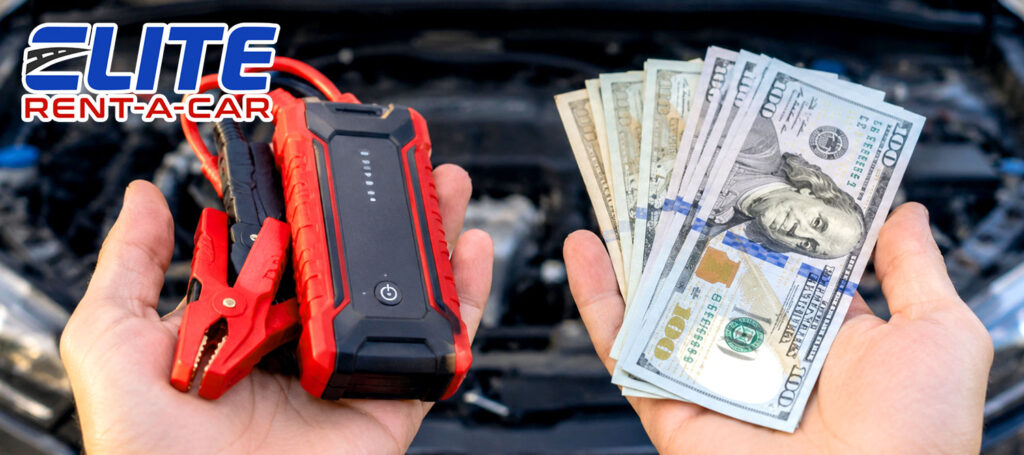
This is the part most guides skip. It is also where renters lose money.
The one line that decides everything
Was it a vehicle fault or a driver fault?
That is the whole test: mechanical failure vs. renter negligence.
When a battery fails on its own, the rental company usually treats it as a mechanical problem and covers the service. When the battery died because the lights were left on overnight, a call-out fee may land on the renter instead.
What “free” roadside really covers
Most rental rates include a basic level of roadside help. In many contracts, that basic level covers only mechanical defects.
Renters stay responsible for using the car properly. For lost keys or an empty tank, help still comes, but the renter-responsible-for-service-fees rule applies. So the answer to “is a dead battery covered by the rental company” is: it depends on the cause.
The paid upgrade
Many companies sell an optional roadside coverage add-on at the counter. It goes by names like roadside assistance protection (RAP) or premium roadside service. These plans usually lower your financial risk for non-mechanical problems. That means lost keys, keys locked inside, flat tires, and running out of gas.
The key difference is simple. A basic plan covers a jump when the fault is mechanical. A premium plan also covers the jump when you caused the drain.
Per-day roadside assistance usually costs a few dollars per rental day. A jump-start service you pay for yourself often costs $50 to $150 in the Houston area. Do the math for your trip length before you say yes at the counter. On a short two-day rental, the rental car roadside assistance fee may cost more than it saves. On a two-week rental in July heat, the value looks different.
Elite customers: our roadside terms are set out in your rental agreement and in our Terms and Conditions. If you are not sure what your rate includes, ask before you drive off, or call 713-227-3777.
Your AAA card already covers rentals
This surprises people. AAA membership covers any vehicle, including rentals, whether you are the driver or a passenger. Many carmaker roadside plans will not help you at all with a rental.
Even the entry-level Classic plan, at $64.99 a year, includes battery jump-start and installation, plus four service calls a year. It also includes mobile battery service. That means on-site battery replacement instead of a tow. Higher tiers add longer tows.
One week of premium counter coverage can cost more than a third of a year of AAA. If you rent often, the membership is usually the better buy.
Your credit card has a ceiling
Credit card rental car benefits are real, but thin for breakdowns. Premium travel cards like the Chase Sapphire Reserve will arrange help and pay a limited amount, often around $50. You pay for anything over that. A jump may be free. A tow and a new battery will not be.
The same limits apply to Visa Signature and Mastercard World Elite cards. American Express Premium Car Rental Protection is strong on damage coverage, but it is not a roadside plan.
The trap: labor is covered, parts often are not
This catches people out. Roadside plans usually cover labor. They do not always pay for the new battery itself. If the unit is dead for good, you may still owe for the part.
Who to call first
| Your coverage | Covers the jump? | Covers battery or tow? | Best used when |
| Basic rental roadside | Mechanical faults only | Usually, if mechanical | Always call this first |
| Premium add-on | Yes, even driver error | Varies by contract | You bought it at the counter |
| AAA membership | Yes, plus installation, subject to plan limits | Battery service: yes (battery purchased separately). Tow: by tier | Backup, after calling rental roadside |
| Credit card | Arranged, about $50 cap | No | Backup only |
| Auto insurance | Often yes | Varies | Backup only |
Even when you use AAA or a card, tell the rental company. Keeping them informed protects you later.
One more thing. Roadside cover is not the same as loss damage waiver (LDW), collision damage waiver (CDW), or supplemental liability insurance. Those cover crash damage, not a flat battery.
Should You Just Jump It Yourself?
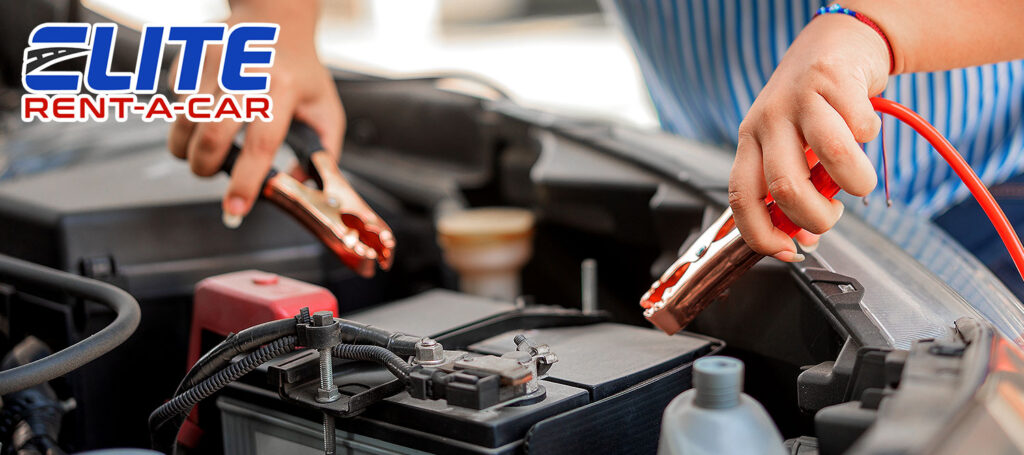
Usually, no. Rule 1 still applies.
But some readers have no signal, no help nearby, and a flight in two hours. If that is you, here is how to jump-start a car safely.
The right order
Follow the jumper cable connection order exactly.
- Park both cars close, but not touching.
- Turn off both engines. Set both parking brakes.
- Open both hoods.
- Connect the red clamp to the positive terminal on the good battery.
- Clamp the red clamp to the positive terminal on the dead battery.
- Connect the black clamp to the negative terminal on the good battery.
- Black clamp to an unpainted engine ground point on the dead car. Keep it away from the battery and fuel lines.
That last step is where people go wrong. The red-black clamp sequence ends on bare metal, not the dead battery post. Mixing up the positive and negative battery terminals can cause sparks or damage.
Start the good car. Let it run two or three minutes. Then try the dead one. If it starts, let both idle about ten minutes. Remove the cables in reverse order.
A jump box is the better travel tool
A portable jump starter pack removes the need for a second car. A modern lithium jump box fits in a carry-on. NOCO Boost is the best-known name. You can pick one up at AutoZone, O’Reilly Auto Parts, or Walmart Auto Care Centers, all of which are easy to find across Houston. Those shops also offer free battery testing if you can reach one.
Common battery brands under the hood include Interstate Batteries, DieHard, ACDelco, Optima Batteries, Bosch, and Duracell.
Tell them anyway
Even if your jump works, call the company. A car that died once can die again. And an unreported problem becomes your problem at the counter.
If Your Rental Is a Hybrid or an Electric Car
Some fleets now include hybrids and electric models. The rules change, so it is worth knowing.
Every electric car has a small EV 12-volt auxiliary battery. AAA explains that it powers the computers that start the car. If it dies, the car will not start even when the big pack is full.
Safety rules from AAA and Kelley Blue Book:
- Never jump the main lithium-ion pack. Only jump the 12-volt unit.
- Never jump an EV with another EV or a hybrid. Use a gas car or a jump pack.
- Unplug the car from any charger first. Skipping this can damage the system.
- Never use an EV to jump another car. Tesla and Nissan both warn against it in their owner manuals.
Jump-starting a hybrid vehicle has its own twist. The 12-volt unit may sit in the trunk, under a floor panel, or under a rear seat. Carmakers often add jump posts in the engine bay instead. Bright orange wiring marks the high-voltage system. Stay away from it.
Honest advice: in an unfamiliar hybrid or EV, call roadside. Do not guess.
Most of the Elite fleet is standard gas-powered, including Toyota, Nissan, and Hyundai models. You can see the full list on our vehicle page.
After the Jump: Swaps, Refunds, and Receipts
Ask for a different car
Do not just drive off. Ask for a rental vehicle exchange. This matters most if you suspect a bad alternator.
The process is built for this. Roadside finds the closest branch to your breakdown point. In some cases, a tow truck dispatch brings a replacement rental car and swaps it with you on the spot. Otherwise, you swap at the nearest branch. Elite has five Houston locations, so a swap is rarely a long drive.
Ask for money back
You lost hours. Say so.
- Ask for a prorated refund for the days you didn’t use.
- Ask about compensation for inconvenience.
- Ask about extending a rental after a breakdown at no extra cost.
A missed flight due to a breakdown may fall under trip interruption travel insurance. Check your policy before you buy a new ticket.
Keep every receipt
Keep receipts and documentation for towing, taxis, and rideshares. Those costs may qualify for reimbursement for out-of-pocket roadside costs later.
If you rent often, use your loyalty program member support line. Those lines usually answer faster.
Watch your paperwork at the end too. An airport rental car return, an after-hours rental return, or one-way rental complications can all cause errors on a final bill.
How to Avoid a Surprise Bill
Here is why step 5 matters.
Renters regularly report being told on the phone that a jump start would be free, then finding a service charge on the final invoice weeks later. Once the car is back and the trip is over, that charge is much harder to fight.
Protect yourself:
- Take photos of the dash, the engine bay, and your location before help arrives.
- Note the agent’s name, the time, and the case number.
- Save every receipt.
- Read the final invoice line by line at the counter.
- If a charge is wrong, dispute an incorrect rental charge in writing.
Start with the rental company. If that goes nowhere, ask your card issuer for a chargeback. Then contact the Texas Attorney General’s Consumer Protection Division. The American Car Rental Association publishes industry practices, and NHTSA handles vehicle safety defects if the car had a known fault.
Read the rental contract terms and conditions before you sign. Carefully review the exclusions in the rental agreement. Elite publishes its rental requirements and terms online, so you can read them before you arrive.
How to Prevent This Next Time
Prevention is cheap. Use these six habits.
- Do a pre-rental vehicle inspection. Take 90 seconds.
- Do a walkaround check before driving off the lot. Listen to the first start. A lazy crank is a red flag. Ask for another car right then.
- Document existing issues at pickup with photos and a quick note to the agent.
- Avoid leaving chargers plugged in overnight.
- Park in shade or covered parking. In a Houston summer, this is the single best habit on this list.
- Pack a portable jump starter for long drives or out-of-state road trips.
One more tip. Snap a photo of the visor roadside number on day one. You will not want to hunt for it in the dark.
Also decide on coverage before you reach the counter. That way, you won’t make a money choice while tired and rushed.
Frequently Asked Questions
Who do I call if my rental car battery dies?
Call your rental company’s roadside line first. The number is on your agreement, in the glove box packet, and often on the driver’s-side visor. Elite renters can call 713-227-3777.
Will the rental company charge me for a jump start?
It depends on the cause. Mechanical faults are usually covered. Driver error, like leaving the lights on, may bring a service fee unless you bought a premium roadside plan.
Does AAA cover rental cars?
Yes. AAA covers you in any vehicle, as a driver or passenger. Even the Classic plan includes jump starts and battery installation, with four calls a year.
Can I jump-start a rental car myself?
You can, but it is risky. A bad connection can cause damage that is not covered. Call roadside first whenever you can.
Am I liable if I left the lights on?
Often yes, at least for the service call. Roadside plans also tend to cover labor only, so you may still be billed for a replacement battery.
How long does roadside take to arrive?
Plan on 45 to 90 minutes inside Houston. Rural areas take longer. Ask for an ETA when you call.
Can I get a different car instead?
Yes. Ask for a vehicle exchange. With five Elite locations across Houston, a swap is usually quick.
What if the battery dies again after the jump?
That points to an alternator or a failing battery. Stop driving it. Ask for a replacement car, not a second jump.
Does my credit card cover this?
Partly. Premium cards arrange help and cover a small amount, often around $50. The rest is yours.
What if it happens after hours or at the airport?
Use the roadside number on your agreement, not the branch line. Our Hobby Airport location is at 7783 Airport Blvd.
Rent With Confidence in Houston
Elite Rent a Car keeps a clean, well-maintained fleet across five Houston locations, including Hobby Airport. Newer vehicles mean fewer battery surprises.
Reserve a vehicle or call 713-227-3777.